Mesa, Arizona, January 5th, 2026, FinanceWire
Michael A. Pollack, president and founder of Pollack Investments, today announced the preservation and private exhibition of what is believed to be the largest surviving collection of carved slot-machine sculptures by mid-century artist Frank Polk. Housed in Pollack’s private museum in Mesa, Arizona, the collection represents a rare intersection of American folk art, Western iconography, and early casino culture.
The announcement formalizes years of private acquisition and conservation by Pollack. The collection includes miners, prospectors, cowboys, Native American figures, and a rare self-portrait, each hand-carved from solid wood and integrated with working vintage slot-machine cabinets. Fewer than one hundred of these sculptures were ever produced, and approximately seventy-two are known to survive today.
“These are not novelties. They’re works of art,” Pollack said. “Frank Polk’s attention to detail, especially in the faces, is second to none. He blended Western themes, storytelling, and gaming in a way that still feels alive decades later.”
Frank Polk’s Vision in the Desert
Polk began producing the figures in 1951 under contract with the Character Manufacturing Company in Reno, Nevada. Each sculpture was carved individually and then fitted with an existing slot-machine mechanism, often Mills or Pace models, skillfully incorporated into the figure’s form. Life-size metal “guns” doubled as slot handles, sculpted expressions conveyed humor and personality, and several experimental sit-down models pushed the boundaries of casino design at the time.
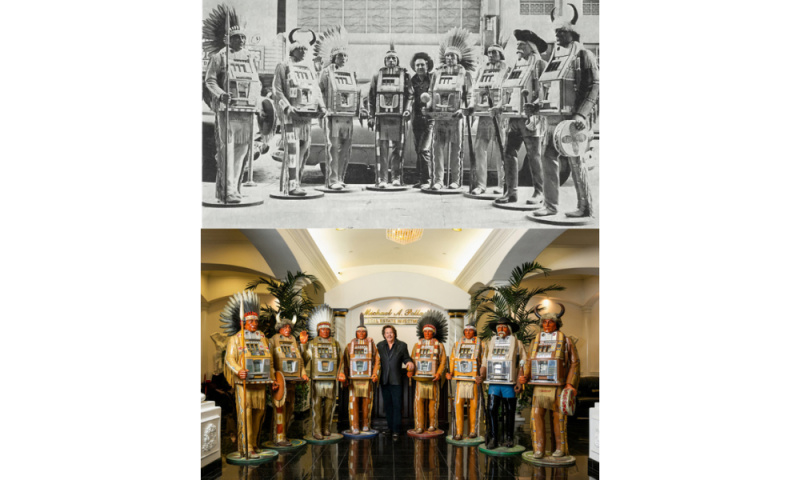
“Hand-carved slot-machine sculptures from Frank Polk’s rare “Indian series,” featured in the April 1980 issue of “Loose Change” magazine, many of which are preserved as part of what is believed to be the largest surviving collection of Polk’s work, housed in the private Mesa museum of Michael A. Pollack, president and founder of Pollack Investments.”
From Frontier Carving to Casino Innovation
Born in 1908, Polk drew inspiration from cigar-store figures and Western storefront carvings. His work caught the attention of casino owner Harry Skelly, leading to the development of six-foot-tall figure slots that replaced neon spectacle with carved storytelling. By 1951 and 1952, Polk’s concept had matured into a distinctive art form that blurred sculpture, entertainment, and mechanical ingenuity.
A Collecting Journey and Cultural Stewardship
Pollack’s effort to assemble the collection spanned years and involved intense competition. He recalls losing a key auction to casino magnate Bill Harrah, only to later acquire the same piece after Harrah’s death. Today, individual Polk sculptures are treated as fine art, with notable sales including a cowboy “One-Armed Bandit” at $43,000 and a Native American carving that sold for more than $100,000.
Among Pollack’s favorites is a John Wayne figure, complete with an interchangeable cowboy hat and raccoon cap, an homage to the cinematic West embodied by Wayne. “It’s playful, cinematic, and pure Polk,” Pollack said.
Preserving Mid-Century Americana
The collection is maintained in Pollack’s private museum, with plans under consideration for institutional collaborations and curated exhibitions. Pollack views the sculptures as social history as much as art, recalling the gamblers who once pulled these wooden levers in places such as Virginia City during the 1950s.
“These machines were played by thousands of people over decades,” Pollack said. “They represent a time when gambling was tactile and theatrical, long before screens and algorithms.”
By formally announcing the preservation of Frank Polk’s carved slot-machine sculptures, Pollack underscores a commitment to safeguarding a singular chapter of American cultural history, one carved face at a time. To learn more, visit www.pollackmuseum.com.
Contact
Holly Morganholly@hollymorganmedia.com