Wilmington, DE, United States, Sept. 10, 2026 (GLOBE NEWSWIRE) -- Food Manufacturers Delaying Natural Color Transition may soon face Structural Supply and Compliance Risks
The shift away from synthetic dyes is no longer a consumer preference signal sitting in survey data. It has become an operational mandate moving through reformulation pipelines at major food manufacturers, and a significant share of ingredient buyers are discovering that clean-label color is harder to secure at scale than expected. The natural food colour market now sits at the center of this recalibration, and the procurement posture is changing faster than the commentary suggests.
What looks externally like a steady, incremental category is structurally a market where supply relationships are being claimed ahead of demand. Stability of hue, heat tolerance, and pH performance separate credible suppliers from the rest, and that technical gap is widening. Companies treating color sourcing as a routine purchase are now competing for capacity against companies treating it as a formulation-critical input with multi-year lead implications.
Request a Free Sample Report: https://marketmindsadvisory.com/request-sample/?report_id=623
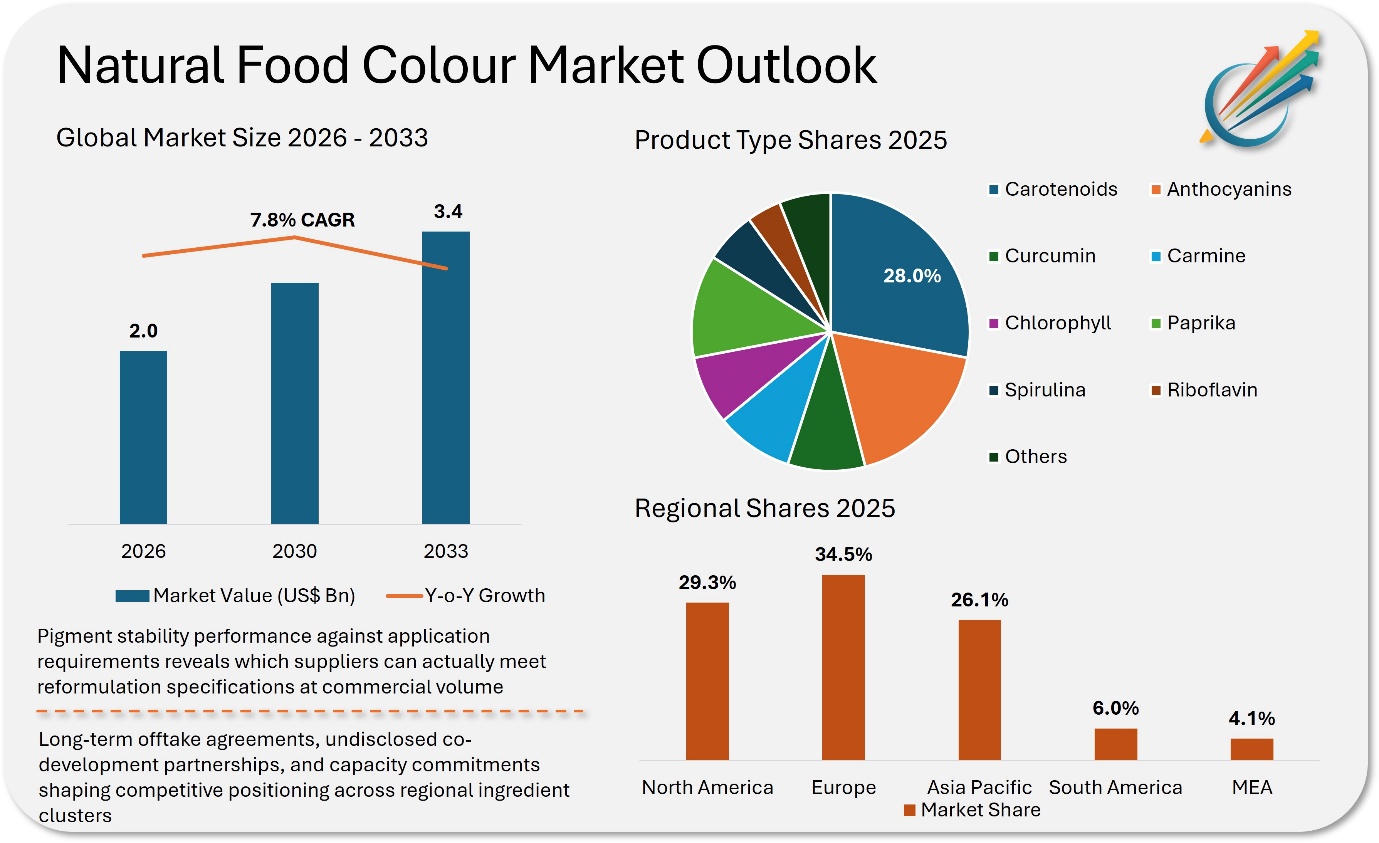
Key Takeaways from Natural Food Colour Market
- The natural food colour market is valued at US$ 2.02 billion in 2026, reaching US$ 3.41 billion by 2033 and is expanding at a CAGR of 7.8%.
- Regulatory pressure on synthetic dyes is accelerating reformulation cycles across packaged food categories.
- Carotenoids and anthocyanins together anchor the majority of plant-based color demand in the natural food colour market.
- Microbial sources such as spirulina are scaling fastest among newer pigment classes.
- Beverage applications remain the single largest demand pool across natural food colour market, led by juices and carbonated drinks.
- Powder form dominates due to shelf stability, transport economics, and formulation flexibility.
As per Research Manager from Market Minds Advisory, "The category has shifted from a marketing-led choice to a supply-constrained engineering problem. Manufacturers that lock in technically validated pigment supply over the next 18 to 24 months will set the cost and consistency baseline competitors spend years trying to match."
Early Movers Locking Application-Grade Pigment Capacity Ahead of Competitors
- Regulatory timelines are compressing: Bans and restrictions on specific synthetic dyes are moving from proposal to enforcement across multiple jurisdictions, leaving manufacturers with shorter reformulation runways than internal planning assumed.
- Technical validation takes longer than sourcing: Matching hue, stability, and cost across an existing product portfolio is a multi-quarter engineering exercise, not a substitution decision, and the natural food colour market rewards early movers.
- Capacity is concentrated: A limited set of suppliers can deliver application-grade pigments at scale, so late entrants are negotiating against firms that already hold preferred supply positions.
Natural Food Colour Market Rapidly Moving from Commodity Pigments to Engineered Color Performance Systems
Natural color is no longer purchased as a single ingredient. It is increasingly specified as a performance system tuned to a specific application, and that change is reshaping how value accrues across the chain.
- Application-specific formulation is becoming the default: Suppliers that deliver color solutions pre-validated for beverages, dairy, or confectionery capture margin that generic pigment sellers cannot.
- Source diversification is now a risk strategy: Manufacturers are deliberately spreading sourcing across plant, microbial, and mineral origins to insulate against crop variability and single-source exposure in the natural food colour market.
- Extraction technology is a differentiator: Supercritical and fermentation-based processes deliver cleaner, more consistent pigments, and the firms that own these capabilities are pulling ahead on both quality and regulatory positioning.
Several Assumptions around Clean-Label Adoption, Supply Stability, and Pigment Scaling already Breaking Down
Demand growth will outpace reliable supply of high-performance pigments before the end of the forecast period. Most commentary assumes raw agricultural availability is the constraint. The binding constraint is application-grade processing capacity, and that gap will define which manufacturers reformulate on schedule.
Carmine and other animal-derived colors will lose share faster than headline figures imply. Vegan-positioning pressure and allergen concerns are pushing brands toward plant and microbial alternatives, and the substitution is structural rather than cyclical.
Consolidation will concentrate around extraction expertise, not pigment volume. The acquirers that win will be those buying validated process technology and regulatory track records, since scale without technical depth is becoming a weaker competitive position.
A New Competitive Structure Is Forming Across the Natural Food Colour Market Ecosystem
Regulatory Convergence Across Major Markets
Synthetic dye restrictions are increasingly aligned across regulatory bodies, removing the option for manufacturers to maintain region-specific formulations indefinitely. This convergence forces global reformulation rather than selective compliance, expanding addressable demand for natural pigments and rewarding suppliers with portfolios already cleared across multiple jurisdictions. The cost of delayed transition is rising as enforcement dates harden.
Clean-Label Expectations Moving Beyond Premium Tiers
Clean-label positioning has migrated from premium products into mainstream and value segments, pulling natural color into categories where price sensitivity is acute. This broadening base changes the economics, favoring suppliers who can deliver cost-effective pigment performance at volume rather than boutique solutions, and it widens the natural food colour market well past its early adopter core.
Microbial and Fermentation-Based Production Scaling
Fermentation-derived pigments are overcoming historical cost and consistency barriers, offering supply independent of agricultural cycles and weather exposure. As yields improve, microbial color becomes a strategic hedge against crop volatility. Companies investing in fermentation capability now are positioning for a structural cost advantage that plant-extraction-dependent competitors will struggle to match later.
Vertical Integration Into Raw Material Supply
Leading suppliers are securing upstream agricultural and cultivation relationships to protect input availability and quality consistency. This integration insulates them from spot-market volatility and gives downstream customers a more dependable supply story. The result is a competitive divide between vertically secured players and those still exposed to fragmented, variable raw material sourcing.
Raw Material Volatility, Stability Constraints, and Supply Concentration Could Moderate Market Expansion
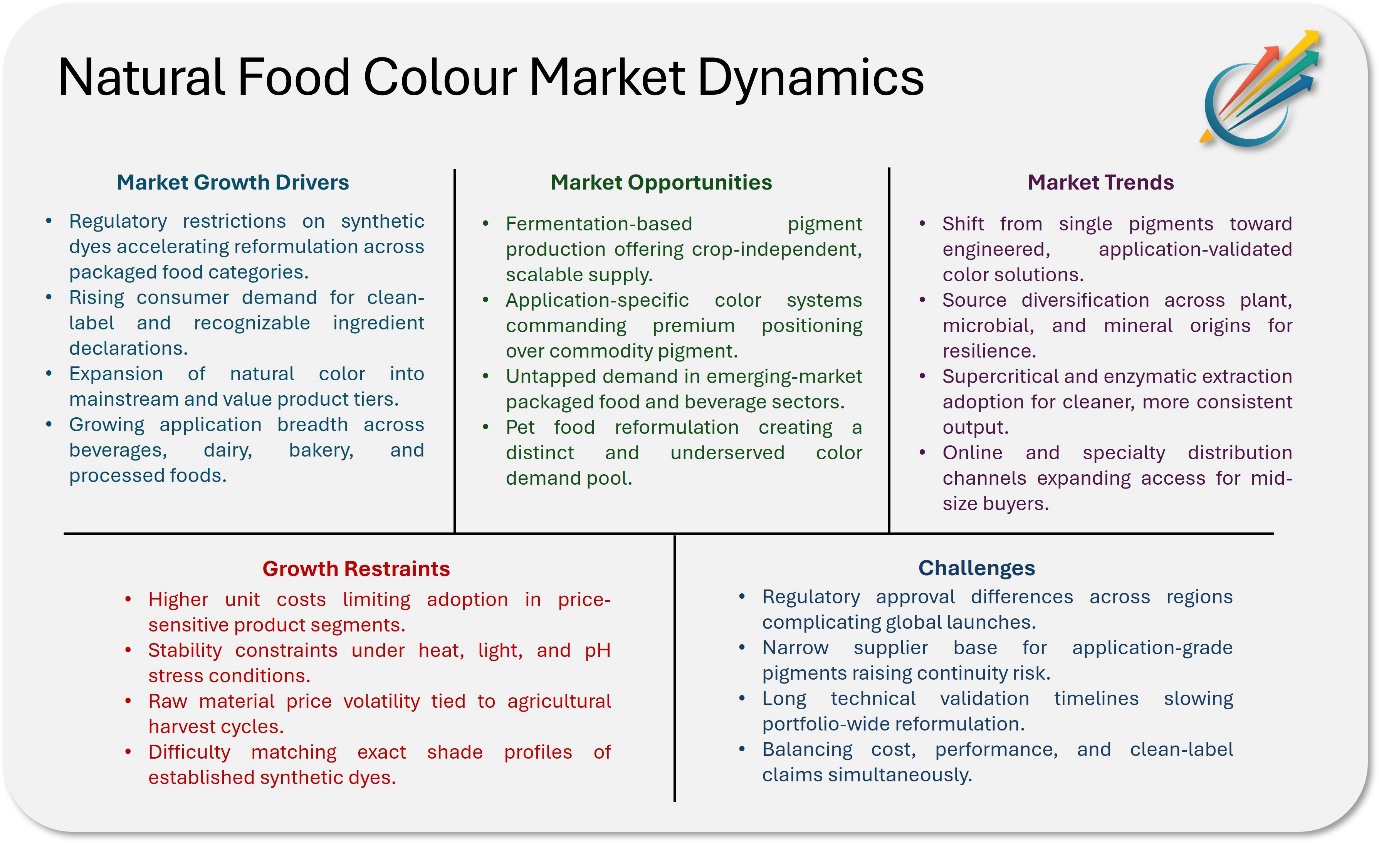
- Raw material volatility: Crop yields for key botanical sources fluctuate with weather and harvest conditions, creating price and availability swings that complicate long-term contracts.
- Stability limitations: Natural pigments remain more sensitive to heat, light, and pH than synthetics, restricting use in certain demanding applications.
- Cost premium: Natural colors typically carry higher unit costs, which constrains adoption in highly price-sensitive product categories.
- Regulatory fragmentation: Approval status for specific pigments still varies by region, complicating global product rollouts and labeling.
- Supply concentration: Reliance on a narrow supplier base for application-grade pigments raises continuity risk for manufacturers reformulating at scale.
- Color-matching complexity: Replicating exact synthetic shades is technically difficult, slowing reformulation in brands with strict visual identity requirements.
These risks are real and warrant disciplined sourcing strategy, but none reverses the directional conclusion. The migration away from synthetic dyes is structural, and the constraints shape execution timing rather than the destination.
Market Dynamics Shaping the Natural Food Colour Market
Natural Food Colour Market Segmentation
By Product Type
- Carotenoids
- Anthocyanins
- Curcumin
- Carmine
- Chlorophyll
- Paprika
- Spirulina
- Riboflavin
- Others
Carotenoids and anthocyanins anchor demand, supported by broad application versatility and well-understood stability profiles. Curcumin and paprika hold durable positions in specific shade ranges, while spirulina-derived blue has unlocked colors that were historically difficult to source naturally. Carmine faces the steepest pressure as vegan and allergen concerns push brands toward plant and microbial alternatives within the natural food colour market.
By Form
- Powder
- Liquid
- Gel
- Paste
- Emulsion
Powder dominates on the strength of shelf stability, transport economics, and formulation flexibility across dry and wet applications all over natural food colour market. Liquid forms serve beverage and dairy lines where dispersion matters, while emulsions address fat-based systems requiring even color distribution. Form selection is increasingly dictated by application engineering rather than buyer preference, reflecting the category's shift toward technical specification.
By Distribution Channel
- Direct Sales
- Distributors and Wholesalers
- Online Retail
- Specialty Ingredient Suppliers
Direct sales dominate large-volume relationships where co-development and technical support are decisive. Distributors and wholesalers extend reach into mid-tier manufacturers, while specialty ingredient suppliers serve niche, high-specification needs. Online retail is emerging for smaller buyers and product developers, broadening access and lowering the barrier to early-stage reformulation across the natural food colour market.
By Source
- Plant Based
- Animal Based
- Microbial Based
- Mineral Based
Plant-based sources lead on consumer acceptance and application breadth, while microbial sources are scaling rapidly as fermentation economics improve. Animal-based color, primarily carmine, is contracting under vegan and allergen pressure. Mineral-based options serve specific functional needs. Source strategy is now a deliberate risk-management decision rather than a default choice in the natural food colour market.
By Extraction Process
- Solvent Extraction
- Supercritical Fluid Extraction
- Enzymatic Extraction
- Fermentation Based Production
Solvent extraction remains widespread on cost grounds, but supercritical and enzymatic methods are gaining traction for cleaner labels and superior consistency. Fermentation-based production is the structural growth story, decoupling supply from agricultural cycles. Extraction capability is becoming a primary competitive differentiator in the natural food colour market, separating technically advantaged suppliers from commodity sellers.
By Application
- Carbonated Drinks
- Juices
- Alcoholic Beverages
- Bakery and Confectionery
- Dairy and Frozen Products
- Meat and Meat Products
- Processed Foods
- Fruits and Vegetables
- Pet Food
Beverages represent the largest demand pool, with juices and carbonated drinks driving reformulation volume. Bakery, confectionery, and dairy follow closely, each with distinct stability requirements. Processed foods present a broad, fragmented opportunity, while pet food is an underappreciated and expanding segment. Application-specific performance now governs supplier selection more than headline price all over natural food colour market.
Shape this report around your priorities: https://marketmindsadvisory.com/request-customization/?report_id=623
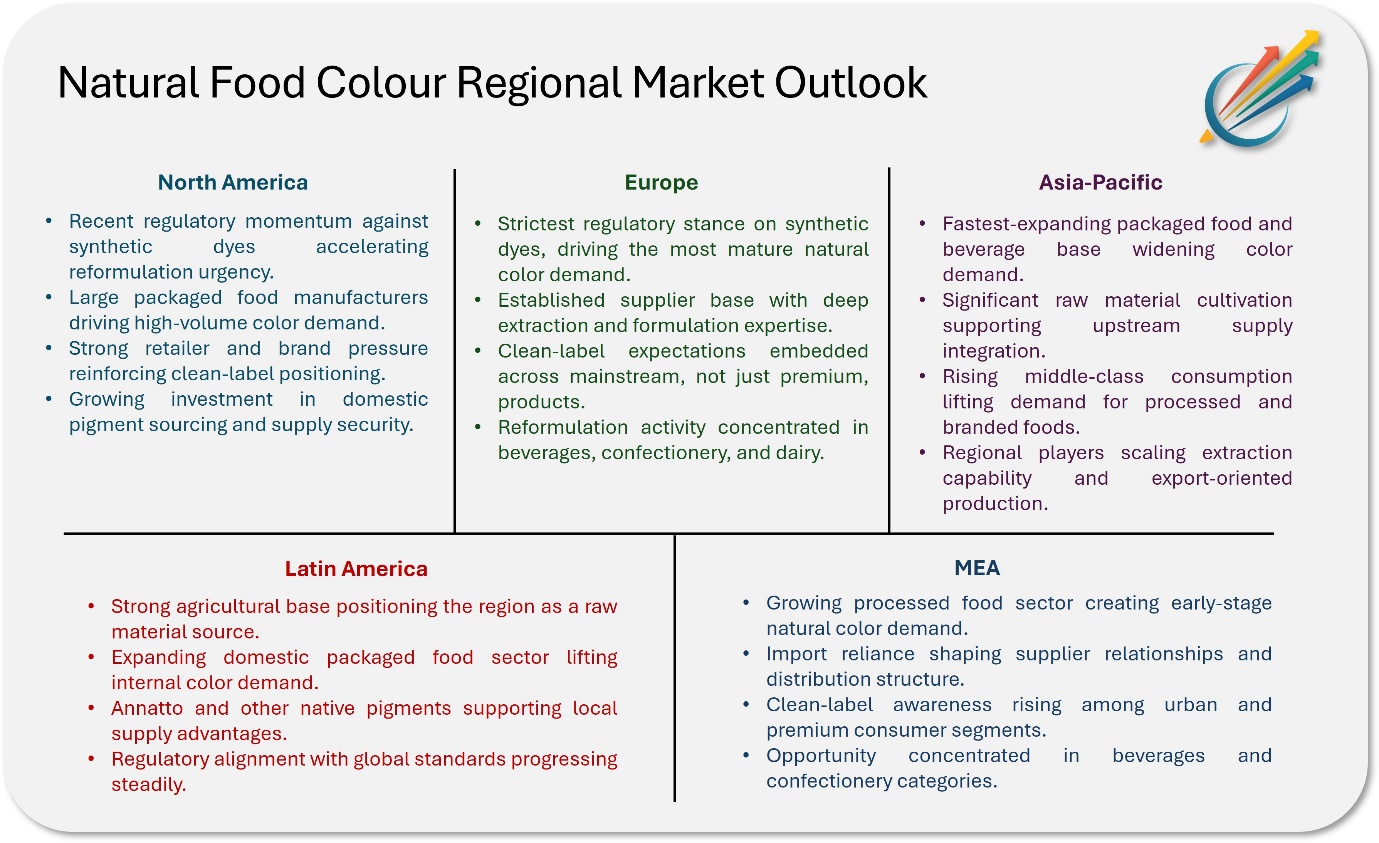
Regional Market Outlook
Investment Focus where the Lucrative Opportunity is Anticipated
Fermentation and Microbial Pigment Capacity
The most durable value sits with firms scaling fermentation-based production. This capability decouples supply from agricultural risk, addresses pigment classes hard to source from plants, and offers a structural cost trajectory. Early capacity holders in the natural food colour market will shape supply economics as demand broadens.
Application-Specific Color Systems
Suppliers that move from selling pigment to delivering validated, application-tuned color systems capture margin and stickier customer relationships. The engineering work behind beverage, dairy, and confectionery solutions creates switching costs that commodity sellers cannot replicate, making this a defensible position.
Vertically Integrated Raw Material Supply
Securing upstream cultivation and extraction relationships protects against input volatility and quality variability. Investors backing vertically integrated platforms gain exposure to suppliers with a more dependable supply story, which is increasingly the deciding factor in large reformulation contracts.
Regulatory-Cleared Multi-Region Portfolios
Pigment portfolios already approved across major jurisdictions carry outsized value as regulatory convergence accelerates. Suppliers positioned for global compliance let multinational manufacturers reformulate once rather than market by market, a meaningful efficiency advantage in the natural food colour market.
What This Means for Decision-Makers
Food and Beverage Manufacturers - Treat color sourcing as a formulation-critical input rather than a procurement step. Securing technically validated pigment supply early protects reformulation timelines and cost structure as regulatory deadlines harden across the natural food colour market.
Ingredient Suppliers - The competitive advantage is shifting toward extraction capability and application engineering. Investing in fermentation capacity and validated color systems builds defensible positioning that commodity pigment volume alone cannot sustain.
Investors - The thesis has matured beyond clean-label sentiment. Process technology, regulatory-cleared portfolios, and vertically integrated supply offer clearer risk-return profiles than broad category exposure within the natural food colour market.
Policymakers - Reformulation pace depends on predictable, harmonized approval frameworks. Regulatory clarity and cross-jurisdiction alignment reduce compliance friction and accelerate the industry-wide transition away from synthetic dyes.
Competitive Landscape: Natural Food Colour Market
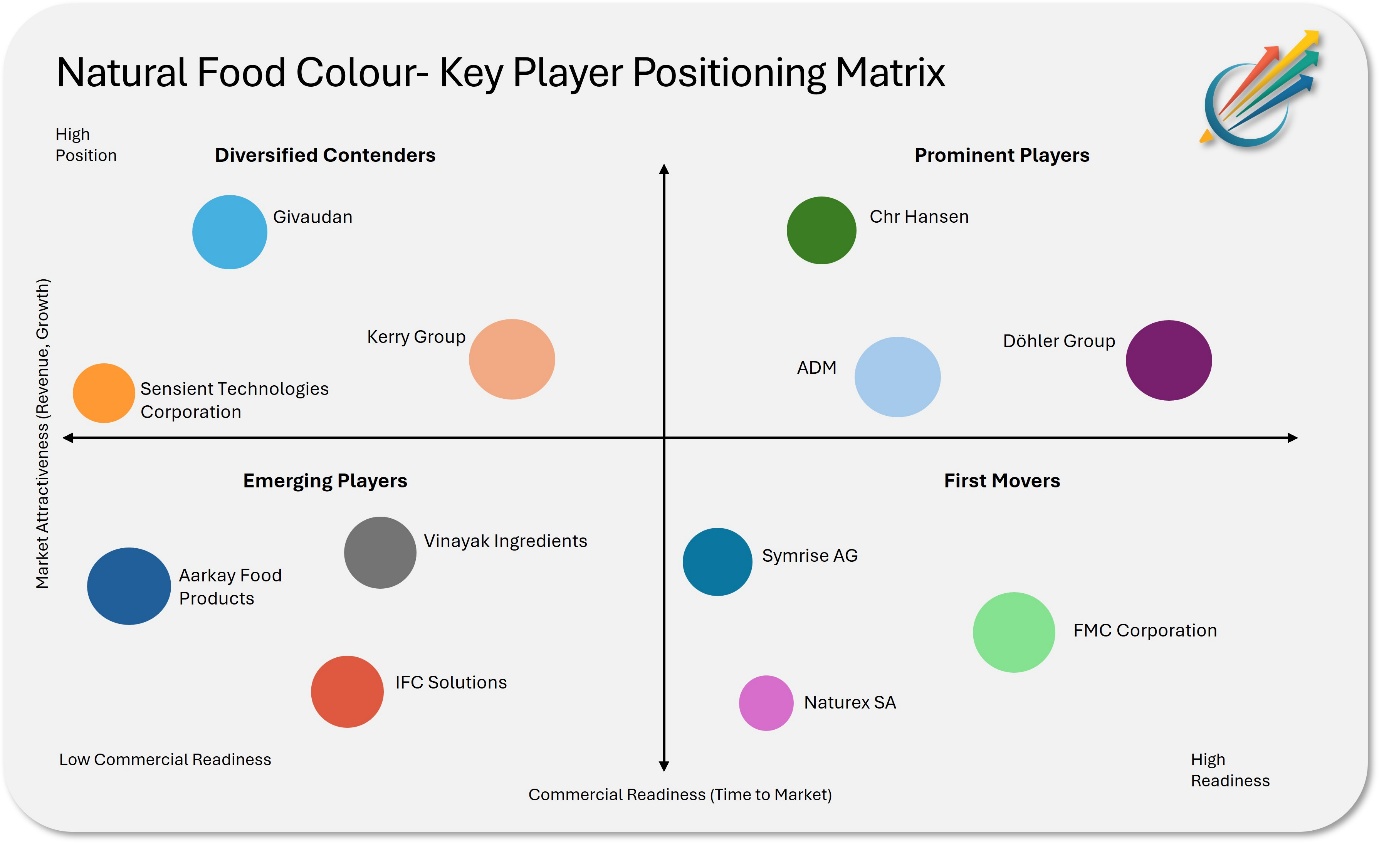
Recent Market Developments
- In April 2026, Givaudan expanded its natural color capabilities through continued investment in its taste and wellbeing division focused on clean-label ingredient solutions.
- In March 2026, ADM advanced its natural colors portfolio with continued emphasis on plant-based and clean-label ingredient development for food and beverage customers.
- In February 2026, Kerry Group reinforced its focus on natural color and clean-label formulation as part of its broader taste and nutrition strategy.
- In December 2025, Sensient Technologies Corporation continued investment in natural color innovation to support manufacturers transitioning away from synthetic dyes.
Market is segmented by Product Type (Carotenoids, Anthocyanins, Curcumin, Spirulina), Form (Powder, Liquid, Emulsion), Distribution Channel (Direct Sales, Distributors, Online, Specialty Ingredient Suppliers), and Source (Plant, Animal, Microbial and Mineral Based)
Get Access to complete Analysis, Buy Now: https://marketmindsadvisory.com/buy-now/?report_id=623
Trending Reports
- Synthetic Food Colors Market
- Natural Solubilizers Market
- Organic Condiments Market
- Vitamin and Mineral Supplement Market
- Plant-Based Ingredients Market
- Packaged Food Market
- Natural X Flavoring Market
- Herbal Fragrance Ingredients Market
- Spirulina Extract Market
- Herb and Spice Extracts Market
Why choose Market Minds Advisory
Market Minds Advisory delivers decision-grade intelligence to executives across machinery, packaging, chemicals, automotive, ICT, food and beverage, consumer goods, and healthcare. We help organizations sharpen market expansion strategies, accelerate share gains, refine brand positioning, and enable account-level growth. Our forecasting integrates primary interviews, proprietary demand models, and continuous market validation, producing the kind of clarity volatile and emerging industries require. Backed by over a decade of sector expertise, our research surfaces white space, opportunity gaps, and competitive blind spots, accounting for recent developments and geopolitical risk. We help businesses see the future of their markets.
Contact Us
Market Minds Advisory
1521 Concord Pike, Suite 301
Wilmington, DE 19803
United States
Email: sales@marketmindsadvisory.com
Website: https://marketmindsadvisory.com/