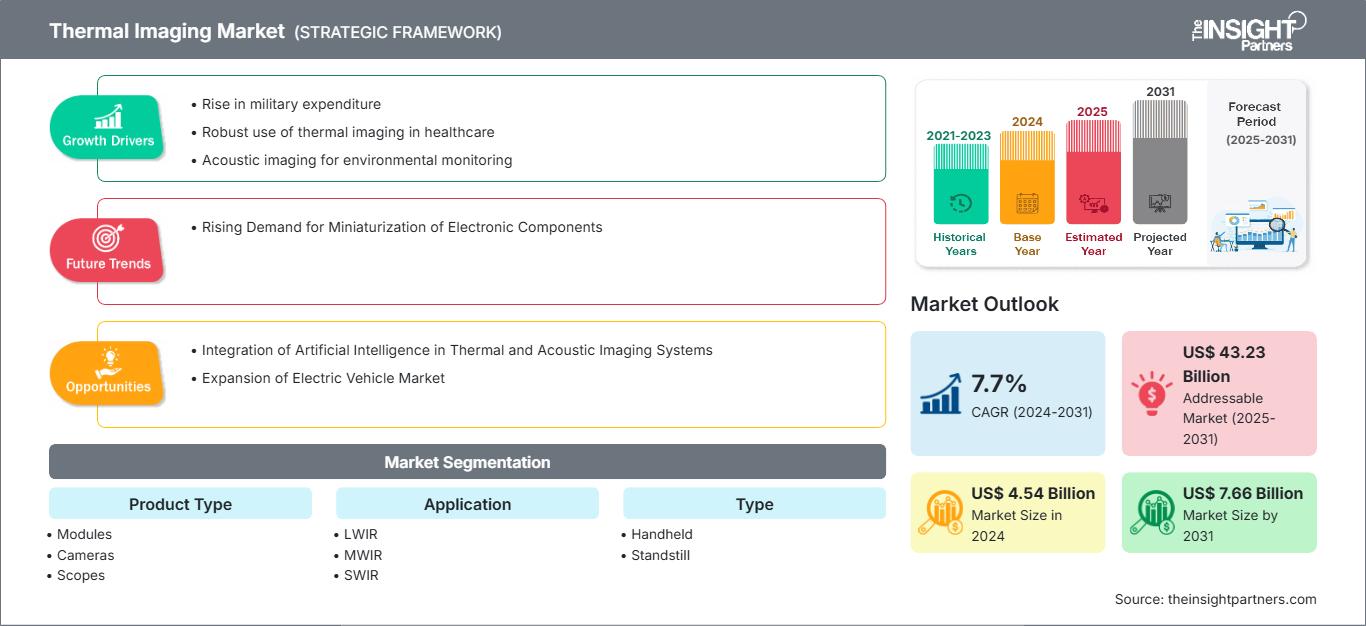
New York, NY,, April 02, 2026 (GLOBE NEWSWIRE) -- A new comprehensive market research report published by The Insight Partners, reveals that the Global Thermal Imaging Market is projected to grow from US$ 4.81 billion in 2025 to US$ 8.78 billion by 2034, registering a CAGR of 7.2% during the forecast period from 2025 to 2031.
Market Growth Highlights:
- Market Projection:
- The US Thermal Imaging Market is registering a CAGR of 6.4% during the forecast period from 2026 to 2034.
- Asia Pacific Thermal Imaging Market size is expected to reach US$ 2,147.6 Million by 2031
- Europe Thermal Imaging Market size is expected to reach US$ 2,434.4 Million by 2031
- North America Thermal Imaging Market size is expected to reach US$ 2,613.6 Million by 2031
- Technological developments, a rise in security requirements, and a surge in industrial applications are a few factors boosting the use of thermal imaging technologies in the US.
- Various industries utilize thermal cameras due to their reduced cost, improved resolution, and small sensor designs. In November 2024, Teledyne FLIR was selected by Red Cat Holdings to provide advanced thermal imaging cameras for the US Army’s new short-range reconnaissance (SRR) drone. Under the agreement, Teledyne will integrate its Hadron 640R+ longwave infrared camera module into the Black Widow unmanned aircraft system (UAS), the Army’s newly chosen SRR platform.
- Primary Growth Driver: In April 2024, global military spending surged amid wars and rising geopolitical tensions, according to the Stockholm International Peace Research Institute (SIPRI). The change in the modern warfare system has urged governments of various countries across the globe to allocate higher funds toward their respective military forces. The budget allocation enables military forces to procure advanced technologies and equipment from domestic or international manufacturers. Various countries are adopting military vehicle modernization practices.
- The continuous demand for new technologies for combat and non-combat operations by the defense forces is further boosting defense spending worldwide.
- Key Segment: Within Product types, Camera remains dominant, while Scopes exhibits the significant CAGR (8.1%).
Download Sample PDF @ https://www.theinsightpartners.com/sample/TIPTE100000348
thermal module is a core component of a thermal camera, consisting of an infrared detector, socket, lens, printed circuit board assembly (PCBA), built-in shutter seat, and ASIC-ISP chip.
Thermal modules use self-developed high-performance infrared detectors to achieve ultra-clear thermal imaging and accurate temperature measurement. This feature makes them useful for rescue operations in smoke-filled buildings and underground facilities. These modules have a variety of applications, including outdoor night vision, temperature measurement, fire prevention, health and medical care, and autopilot.
Increasing Use in Autonomous Vehicles, Robotics, and Drones Powers Operational Efficiency and Industry Expansion:
The increasing use of thermal imaging in autonomous vehicles, robotics, and drones is creating significant growth opportunities for the thermal imaging market. Thermal imaging systems detect heat signatures rather than relying on visible light, which allows machines to perceive their environment even in low-light, foggy, smoky, or nighttime conditions. This capability is crucial for technologies that must operate autonomously and safely without constant human supervision.
In autonomous vehicles, thermal cameras enhance perception systems by helping detect pedestrians, animals, and obstacles that may be difficult for traditional cameras or LiDAR to recognize in poor visibility. By improving object detection and road awareness, thermal imaging contributes to safer navigation and supports the development of advanced driver-assistance systems (ADAS) and fully self-driving vehicles.
Similarly, in robotics, thermal imaging enables robots to perform tasks in hazardous or visually limited environments such as industrial facilities, disaster zones, and dark indoor spaces. Robots equipped with thermal sensors can identify heat leaks, detect equipment overheating, or locate humans during search-and-rescue missions. For drones, thermal imaging greatly enhances situational awareness. It is widely used in applications such as surveillance, wildlife monitoring, infrastructure inspection, firefighting, and security operations.
Major Industrial Liquid Filters Companies Include:
- Teledyne FLIR LLC
- Testo SE & Co. KGaA
- Fluke Corporation
- UNI-TREND TECHNOLOGY (CHINA) CO., LTD.
- Hangzhou Microimage Software Co., Ltd.
- Megger Group Limited
- SDT International SA/NV
Thermal Imaging Market Segmentation Analysis:
MWIR, thermal imaging Segment to Grow at the Highest CAGR
Middle wavelength infrared (MWIR) is typically defined as the 3.0–5.0 μm wavelength range. MWIR cameras are used as detection systems for gas leaks such as methane, propane, ethanol, and sulfur hexafluoride.
Drones with mounted MWIR cameras are used for safety inspections of machinery and infrastructure that contain pollutants and toxic gases. These cameras are also used when precision is more important than exact temperature, enabling their Application in airport perimeter security and laboratory research for engineers and scientists.
MWIR cameras offer crisp imagery, precise temperature measurement, and streamlined analysis capabilities required for industrial, military, and manufacturing research and development applications. Such features fuel the demand for MWIR from the industrial, manufacturing, and defense sectors.
Cameras to Hold the Largest Market Share
Thermal cameras detect invisible heat radiation emitted or reflected by all objects, regardless of lighting conditions. These cameras work on the principle that all objects with a temperature above absolute zero emit infrared radiation, and the amount of radiation emitted varies with temperature; the hotter the object, the higher the frequency of that radiation. These cameras are designed for noncontact temperature measurement.
Also, these devices are widely adopted for various applications such as building and home inspections, electrical and mechanical maintenance, security and surveillance, automotive diagnostics, agricultural monitoring, firefighting and search & rescue, and research & development (scientific).
Defense and Aerospace Segment to Dominate End Use Industry Adoption
Military thermal cameras are used as rugged infrared and night vision cameras for surveillance, patrolling, security, and weapons targeting. Thermal imaging technology can scan broad areas through aircraft; these cameras are used as a guidance system to avoid collision at sea and help identify, locate, and target enemy forces. Long-range, mounted, and rugged thermal imagers for combat vehicles help in rapid identification and threat location for the military forces. Due to the diverse applications of thermal imaging technology, military forces are increasingly adopting this technology for surveillance activities.
Thermal cameras with extremely high thermal resolution are frequently needed for measurement tasks in the aerospace industry. The aviation authority's high safety and reliability requirements necessitate accurate analyses of aero-engine thermal behavior. Further, quality controls on aircraft fuselages, wings, and rotor blades, as well as helicopters, can be carried out using infrared camera systems to conduct efficient fault analyses.
Europe shows higher growth:
Europe had second largest share of the market in 2025. The automotive sector employs 13.8 million Europeans directly and indirectly, accounting for 6.1% of all EU jobs; 2.6 million work directly in the field of manufacturing motor vehicles, accounting for 8.5% of all EU manufacturing jobs.
The EU is one of the world's largest producers of motor vehicles, and the automotive sector is the largest private investor in research and development, according to data from the European Commission. With the implementation of important policy goals such as the digitization of the transportation industry, including green transportation, road transport automation is at the top of the European Commission's agenda. The thermal imaging solution is one of the major applications in these sectors. Thus, the overall development in the automotive and manufacturing sectors is driving the market in the region.
To explore the valuable insights in the Thermal Imaging Market report, you can easily check a sample PDF of the report – https://www.theinsightpartners.com/sample/TIPTE100000348
Thermal Imaging Market Dynamics:
Driver: Robust use of Thermal Imaging in Healthcare
A thermal image shows elevated temperatures, which might lead to potential issues such as inflammation, circulation problems, injuries, or infections. Medical thermal imaging is widely used for different purposes, including monitoring body temperature for early signs of illness and diagnosing various conditions. Various organizations are focused on developing thermal imaging solutions. For example, in April 2024, IDC and the National Physical Laboratory (NPL) collaborated to develop a Thermology Health thermal imaging device that facilitates full foot temperature mapping and is ten times more accurate than existing products.
Opportunity: Integration of AI in Thermal and Acoustic Imaging Systems
The integration of artificial intelligence (AI), supported by its capabilities in machine learning, data processing, and pattern recognition, can enhance the performance and utility of thermal and acoustic imaging systems across defense, environmental monitoring, healthcare, and other industrial applications. AI can improve the accuracy and effectiveness of thermal and acoustic imaging systems with the help of advanced data analysis and interpretation techniques. These imaging technologies generate vast amounts of data, where AI algorithms can analyze hidden patterns much faster and more accurately than traditional methods. AI can also detect anomalies or potential threats in the data.
Compared to traditional methods, AI-based intelligent acoustic imaging techniques can autonomously, efficiently, and accurately identify underwater targets. Market players are also focused on launching innovative solutions. For example, in January 2024, Hanwha Vision launched advanced AI-powered radiometric thermal camera lineups. These next-generation devices surpass basic security by combining artificial intelligence with temperature detection and high-performance imaging to deliver unparalleled solutions for power plants, factories, and oil and gas utilities.
Challenge: High Initial Cost of Thermal Imaging Devices
The high initial cost of thermal imaging devices, particularly cooled thermal cameras, is a significant factor that restricts the growth of the thermal imaging market. Thermal imaging systems use advanced infrared sensors, specialized optics, and complex calibration technologies to detect heat signatures and convert them into visual images. These sophisticated components increase manufacturing costs, making the devices expensive compared to conventional imaging systems.
Cooled thermal cameras are especially costly because they contain cryogenic cooling mechanisms that reduce sensor noise and improve image sensitivity and resolution. While these cameras offer superior performance for applications such as defense, aerospace, and scientific research, their price can be prohibitively high for many businesses.
Purchase Full Report (2025–2031 Forecast):
https://www.theinsightpartners.com/buy/TIPTE100000348
Recent Developments:
- In August 2025, Teledyne will showcase their newest products and vision solutions at the Automation Expo 2025 exhibition taking place August 11-14 in Mumbai, India. Teledyne’s DALSA, FLIR IIS, and FLIR Solutions businesses will display a range of imaging products—from components to integrated systems. Visit Teledyne booth # L1, at Hall 6 and experience live demonstrations of the company’s advanced technology from your one source for unlimited vision solutions partner.
- In January 2026, Teledyne Judson Technologies, a Teledyne Technologies announces the launch of the SCION Family of SWIR cameras—a new line of high-performance, high-volume cameras for demanding applications. The SCION platform introduces a new class of SWIR imaging solutions with a 10-micron pixel pitch and formats of 640x512 and 1280x1024, combining Teledyne’s decades of high-sensitivity sensor expertise with the speed, agility and cost-efficiency required in hyperspectral imaging, biosciences, space & defense and semiconductor markets.
Trending Related Reports:
- Thermal Imaging Cameras Market Developments, Trends, Analysis, and Forecast by 2031
- Military Thermal Imaging Market Report 2031 by Segments, Geography, Dynamics, Recent Developments, and Strategic Insights
About The Insight Partners
The Insight Partners is a global market research and consulting firm delivering in-depth analysis and actionable insights across technology, media, telecommunications, healthcare, and industrial sectors. The firm supports organizations in identifying growth opportunities, understanding market dynamics, and making informed strategic decisions.
Contact Us:
If you have any queries about this report or if you would like further information, please contact us:
Contact Person: Ankit Mathur
E-mail: sales@theinsightpartners.com
Phone: +1-646-491-9876